
The RYS 200 requirements come down to four things: a curriculum covering Yoga Alliance’s four educational categories, a lead trainer who holds the E-RYT 500 credential, a way to assess every trainee, and an application that explains how you will do all of it. Yoga Alliance reviews the application and decides, so the work is to show clearly that your training meets each standard.
We went through this with Loka Yoga School in Bali, which has been a Registered Yoga School since December 2017. Here is what the standards ask for, in the order you will need to deal with them.
In short
In this guide
RYS stands for Registered Yoga School. An RYS 200 is a school that Yoga Alliance has recognised to offer a 200-hour teacher training, and its graduates can then apply to register as RYT 200 teachers. Your school applies; Yoga Alliance decides. Nobody can promise you the outcome in advance, including a curriculum provider.
Registration is optional. You can run a training without it, and we cover that choice in our guide to running teacher training without Yoga Alliance. Schools registered before 2020 may still operate under the previous five-category framework; a new application uses the four-category core described here. But most people who want to teach ask whether your training lets them register, and the answer shapes who enrols.
Every RYS 200 teaches the same core curriculum, which Yoga Alliance calls the common core. It is split into four educational categories, each with a set number of hours:
Those four add up to 185 hours. The remaining 15 hours are for your school to decide, which is where your lineage and speciality show. Check the current standards for the exact wording before you finalise a schedule.
Hours alone are not enough. Within each category, Yoga Alliance lists competencies and sub-competencies, and the application asks you to describe what your training covers for each one. In Anatomy and Physiology, for example, that means the skeletal system, major muscles, the nervous system and the stress response, the respiratory system, and biomechanics.
This is the part that takes time. You need to be able to point to the page in your manual and the session in your schedule where each competency is taught. A curriculum mapped to the categories from the start makes this a matter of copying across, rather than reverse-engineering a training you have already written. The competencies inside each category are listed in our guide to what a yoga teacher training curriculum must include, and the application system asks for at least half an hour of training per sub-competency.
Lead trainers are where many applications are won or lost. An RYS 200 may have between one and five lead trainers, and all of them must hold the E-RYT 500 credential and be members in good standing. Between them, lead trainers must teach at least 150 of the 200 hours.
Other trainers on your team must be registered teachers with Yoga Alliance. You can also use other faculty who are not registered, for example a physiotherapist teaching anatomy, provided they hold a relevant degree, certification or substantial education, and either 500 hours of teaching experience or two years of relevant experience.
If you do not yet have an E-RYT 500 on your team, that is the first problem to solve, and it is worth solving before you spend anything on manuals. The usual options are to bring in an E-RYT 500 as co-lead for the first cohorts, or to wait until your own designation qualifies.
Yoga Alliance allows trainings to run fully in person, fully online, or a mix of both. Schools that include distance learning must deliver at least 15% of the programme live, with teachers and students together online at the same time. For a 200-hour training, the standards set the minimum at 30 synchronous hours.
If you plan to run part of your training online, build the live sessions into the schedule from the start, and say so clearly in the application.
The standards expect a school to explain how it will assess trainees in each educational category, and Yoga Alliance’s guidance is that a school should not graduate someone simply because they turned up. Trainees should show they can apply what they have learned.
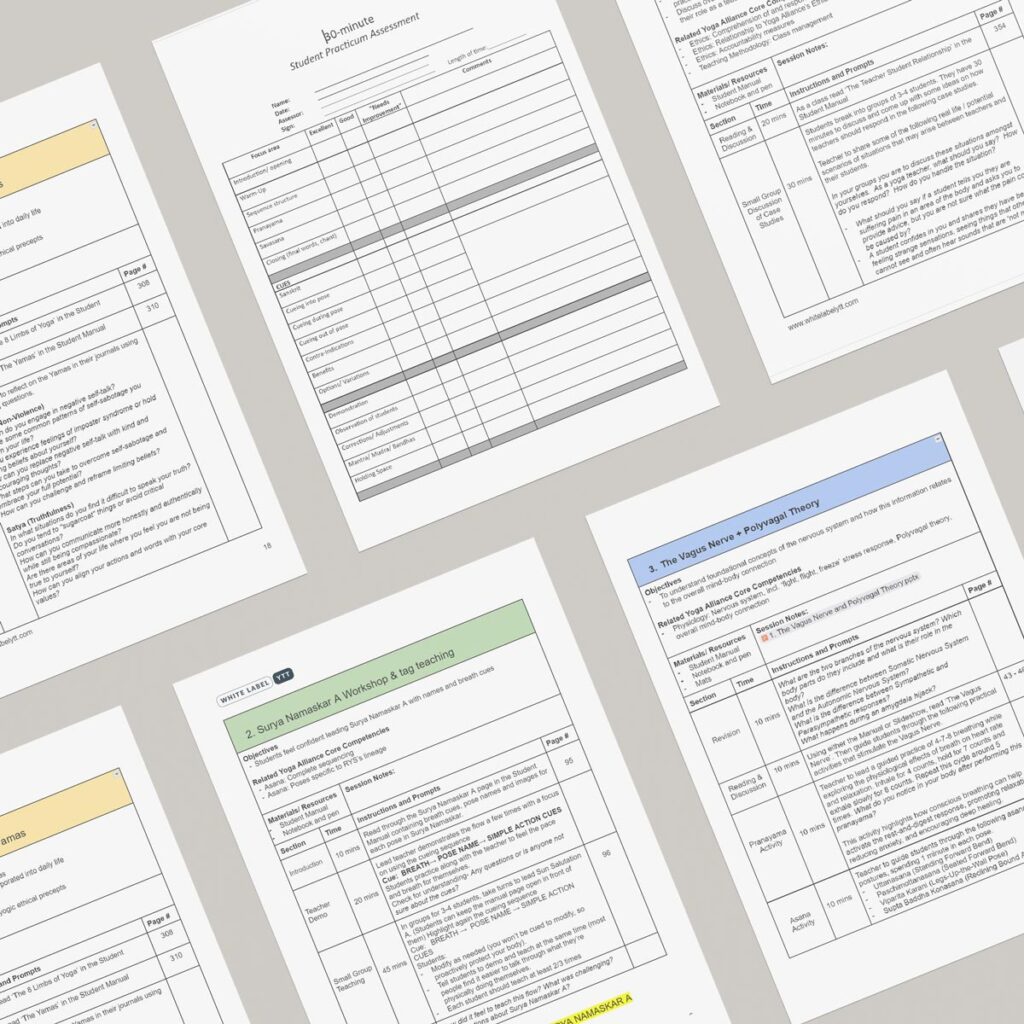
In practice that means a written or oral check in each category, observed practice teaching with feedback, attendance records, and a practicum where each trainee leads a class. It also means a written policy for what happens when someone misses hours or is not ready. We include assessment forms for each subject and body system, plus a practicum assessment, in our handouts so you are not inventing them in week one.
Gather these first, and the application itself becomes a writing exercise rather than a scramble:
In October 2026 Yoga Alliance’s own site listed a one-off application fee of US$400 and an annual membership fee of US$240 per credential. Fees change, so check the current schedule before you budget. Allow time for questions back from the reviewer. The wider project, from lead trainer to first cohort, is in our guide to how to create a 200-hour yoga teacher training, and the budget side in the cost to run a yoga teacher training.
Much of the application is documentation, so a curriculum written to the four categories saves the most time here. The White Label YTT package includes four student manuals and four teacher manuals, one for each educational category, a class plan for every class and workshop, 16 printable handouts covering policies and assessment, and registration guidance with application text you can adapt to your own school. You still write the application and you still decide how to teach it, but you start from a structure built to the same four categories as Loka’s own registered training.
The complete package page lists everything that is included, and our guide to what white label yoga teacher training includes explains how the licence works. To see the standard of our own school’s record, you can view Loka’s Registered Yoga School profile, or read how we run the training itself on Loka’s 200-hour yoga teacher training page.
White Label YTT is a done-for-you 200-hour yoga teacher training curriculum, licensed to studios and teachers by Taryn Weggelaar and Yann Cadic, founders of Loka Yoga School in Bali.
If you are weighing up how much work registration will take, look at the real materials first. The free training sample shows a manual chapter and a class plan, so you can judge whether the depth matches what the standards ask for.
If you would like to talk through your lead trainer situation or your timeline, book a short call with us. We will tell you honestly where you stand.
A curriculum covering Yoga Alliance’s four educational categories, at least one E-RYT 500 lead trainer, a method for assessing trainees, and an application describing how you meet each standard. Yoga Alliance reviews it and decides.
Techniques, Training and Practice is 75 hours, Anatomy and Physiology 30, Yoga Humanities 30, and Professional Essentials 50. Check the current standards before you finalise your schedule.
Yes. An RYS 200 may have one to five lead trainers, all holding the E-RYT 500 credential, and they must teach at least 150 of the 200 hours.
Yes. Trainings can be in person, online or a mix, but at least 15% of the hours must be live, with teachers and students online together. For a 200-hour training, that is 30 hours.
It depends on how ready your documents are and on how many questions the reviewer asks. Yoga Alliance sets the review timeline, so check their current guidance. What you control is arriving with manuals, a schedule and assessment methods ready.
No. Many schools apply with a licensed curriculum and adapt it to their own lineage and team, but the application must describe your training as you will actually teach it.
Chat with Taryn!